
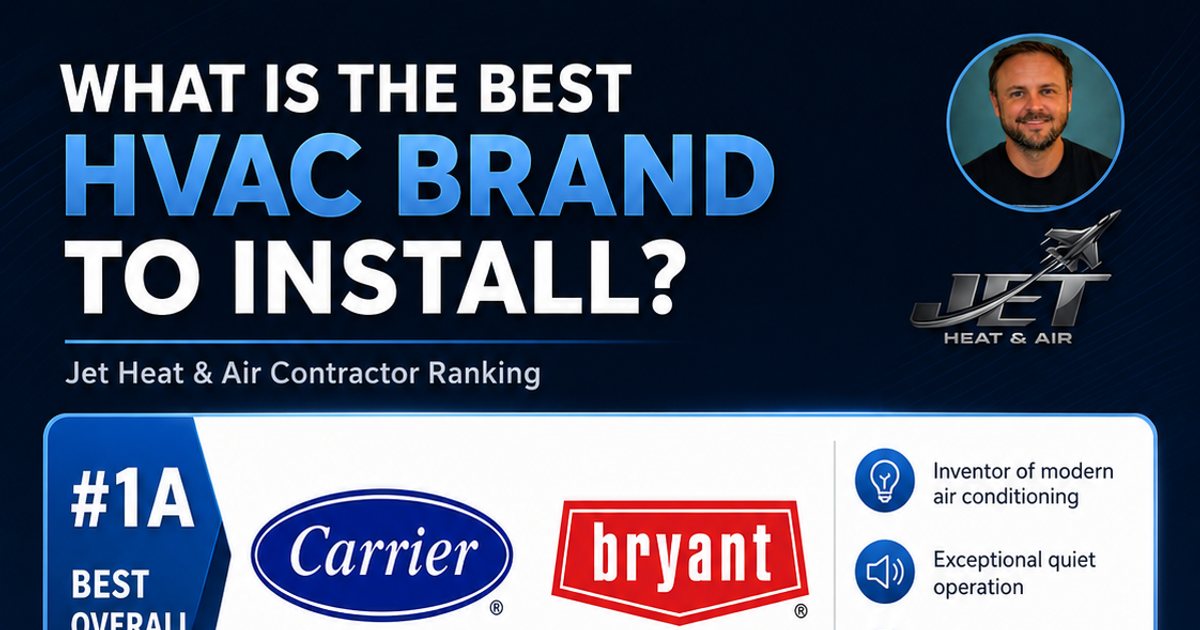
"What's the best AC brand?" is the most common question we get before a system replacement — and it's the wrong first question. But since you're going to ask it anyway, I'll answer it straight, the way I'd tell a neighbor over the fence. Then I'll tell you the thing the brand-ranking blogs won't, because it doesn't sell ad clicks: the badge on your condenser decides maybe a fifth of how happy you'll be. The other four-fifths is who installs it.
Full disclosure up front: we install American Standard, Carrier, and its sister brand Bryant — so I sell most of the names near the top of this list. I still rank Carrier number one on the facts, with American Standard a near-tie right behind it. I grade on reliability reputation, warranty, parts availability, and value — not on which line we happen to stock. We repair every brand on this list every week, so I see how they all age in real Arkansas homes, and my recommendation always starts with your house and budget, not our margin.
The short version
Top 5 air conditioner brands, ranked
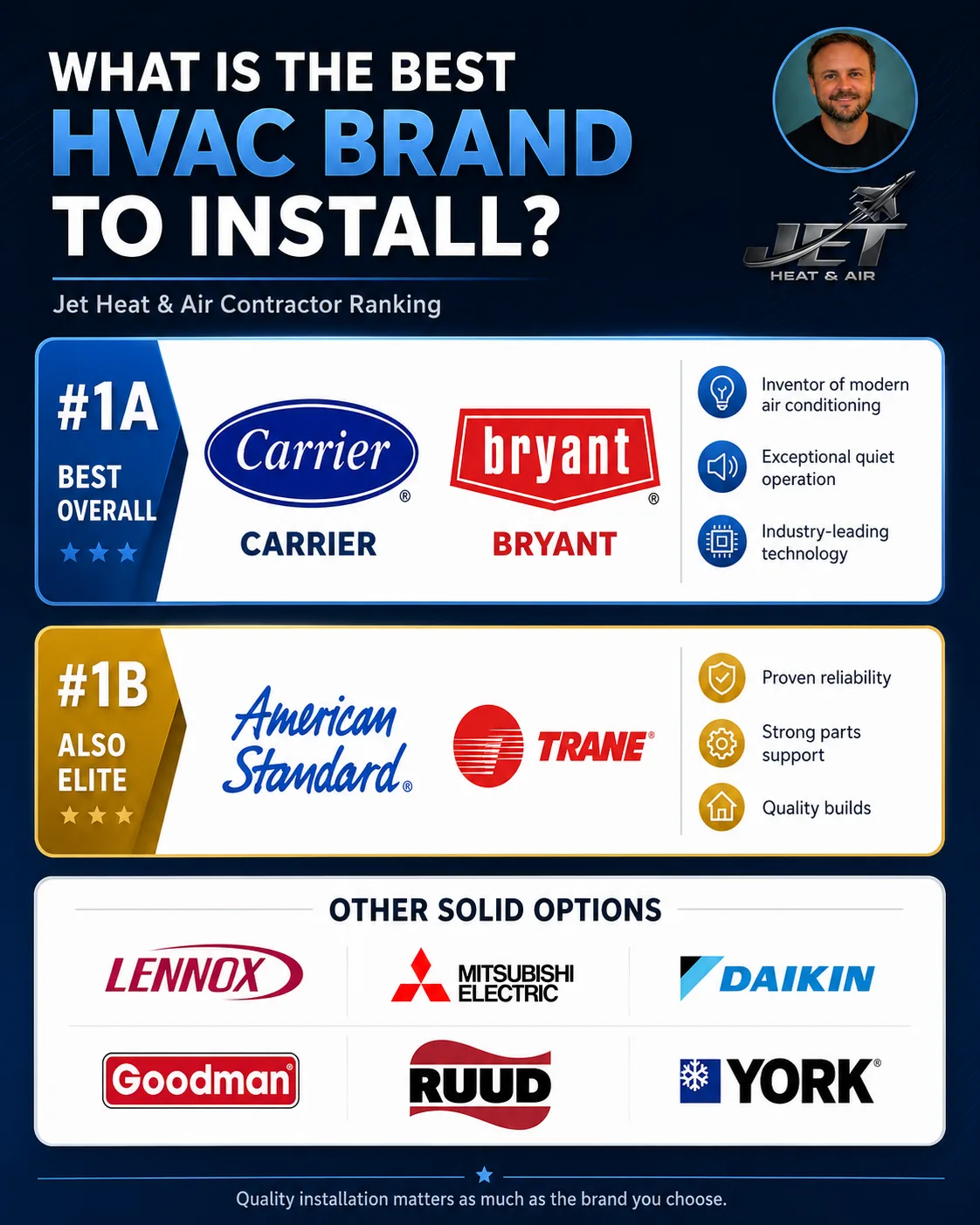
If you only read one part of this, read this. Here is who makes the best heating and air conditioning units in 2026, graded on reliability, warranty, parts availability, and value — from a contractor who repairs all of them every week:
- Carrier (and Bryant) — best overall. Rock-solid reliability, parts everywhere, strong warranty.
- American Standard (and Trane) — a near-tie for first. Built like a tank, forgiving of imperfect ductwork.
- Lennox — highest efficiency numbers you can buy, with pricier proprietary parts out of warranty.
- Rheem / Ruud — the value sweet spot. Solid equipment, widely available parts, less money.
- Goodman / Amana / Daikin — the budget workhorses with genuinely strong warranties, if the install is done right.
Brands to avoid? Not a big name — see where the "worst" reputation really comes from below. The short answer: avoid no-name equipment and any brand installed by someone who didn't measure your house.
How I'm grading
The five things that actually separate brands
Forget the marketing SEER numbers for a second. When I judge a brand, I'm weighing five things that show up years later in your repair bills:
- Build quality — compressor, coil metal, cabinet, and controls. Does it feel overbuilt or cost-cut?
- Warranty — how long, what's actually covered, and whether registration is required to get the full term.
- Parts availability & repair cost — common universal parts vs. proprietary parts you wait a week for and pay a premium to replace.
- Efficiency range — how high the lineup goes if you want lower power bills.
- Value — what you actually get for the dollar, which is not the same as "cheapest."
The top of the list
#1 — Carrier (& Bryant)
Carrier is my number one, full stop — and I say that as a guy who sells a different brand. Carrier invented modern air conditioning, and the equipment still reflects it: heavy, durable build, excellent compressors, quiet operation, a deep parts network, and warranties that hold up. Bryant is the same company and the same core engineering at a slightly friendlier price — think of it as Carrier's value badge. If money's roughly equal and you want the surest bet on the market, this is where I'd point my own family.
#2 — American Standard & Trane
Right on Carrier's heels — and yes, this is one of the brands we install. American Standard and Trane are the same company, and they build some of the most robust, forgiving equipment in the business. That word forgivingmatters more than people realize in Central Arkansas: these units tolerate the older, imperfect ductwork in a lot of our homes better than the tightly calibrated budget lines do. Rock-solid compressors, strong warranties, and a build quality you can feel. A razor-thin second to Carrier, and for a lot of homes the practical difference is zero.
Everything below the top two
The rest of the pack — good equipment, pick on price and installer
Here's the honest part most ranking articles pad out to look authoritative: below the top two, the differences get small enough that who installs it matters more than which one you pick. These are all legitimate brands that run for fifteen years when they're sized and installed right. So I'm not going to pretend there's a meaningful gap between spots four and nine — there isn't. Pick on price, warranty, and especially your contractor.
Lennox earns a premium mention for some of the highest efficiency numbers you can buy — with one honest caveat every installer will tell you: it leans on more proprietary parts, so out-of-warranty repairs can cost more and take longer. Rheem and Ruud (same company) are the value sweet spot — solid, widely available parts, real efficiency range, less money. Goodman, Amana, and Daikin (one Daikin-owned family) are the budget workhorses with genuinely strong warranties; the current equipment is legitimate, it's just less forgiving of a sloppy install — the exact trap I broke down in why a new Amana chokes on old ductwork. Mitsubishi Electric is the name to beat if you're going ductless — the gold standard in mini-splits for spot cooling, additions, and rooms that never keep up. York, Coleman, Luxaire (Johnson Controls) and Heil, Tempstar, Comfortmaker (the ICP family) are competent mid-market equipment — fine at the right price, nothing to fear and nothing to pay premium money for.
Approach with eyes open
Air conditioner brands to avoid — and where the "worst" reputation actually comes from
Here's where the clickbait rankings scream a brand name. I won't, because it isn't true. Every established manufacturer on this page builds equipment that runs for fifteen years when it's sized, installed, and maintained right. The genuinely bad outcomes come from two places, and neither is a Tier-1 nameplate:
1. Truly off-brand, no-name equipment
Bargain units from names you've never heard of, with thin parts networks and warranties that evaporate when you file a claim. When the compressor goes at year four and nobody stocks the part, the "deal" becomes the most expensive AC in the neighborhood.
2. A bad install of any brand — even a great one
This is the real "worst brand." An oversized system that short-cycles and never dehumidifies. A unit choking on undersized ducts. A refrigerant charge eyeballed instead of weighed. Do that to a Trane and it'll disappoint you exactly like a no-name would — it'll just take a little longer to die.
The part nobody sells you
The badge is 20%. The install is 80%.
I've walked into homes with a top-of-the-line premium system that runs loud, cools unevenly, and racks up power bills — because it was oversized and slapped onto ductwork built for a 1990s furnace. And I've seen budget-brand systems, sized right and installed clean, run quiet and trouble-free for fifteen years. The equipment was never the variable. The person on the ladder was.
So when you're shopping a replacement, spend less energy on the logo and more on these four questions for whoever's quoting you:
- Did they do a Manual J load calculation to size the system to your actual house — or just match what's there?
- Did they measure your ductwork and static pressure before quoting?
- Will they weigh the refrigerant charge, not guess it?
- Are they licensed and insured, and will they put the warranty terms in writing?
A contractor who does those four things will get you a better outcome with a value brand than a lowball outfit will with a premium one. We covered the flip side of this — the tricks to watch for — in how to spot an HVAC scam in Central Arkansas.
The bottom line
So what should you actually buy?
If you want the surest bet and can swing it: Carrier or Bryant at number one, American Standard or Trane a hair behind — and you'll likely never think about it again. If you want the most comfort per dollar: a value brand (Rheem, Ruud, Goodman, Amana) installed by someone who measures twice. Either way, the brand is the easy part — picking the contractor is the decision that actually determines whether you're happy in August.
When you're ready to talk it through — no quota, no pressure, just an honest read on your home and budget — we do system replacements across Central Arkansas and we'll tell you the truth about what you actually need. Get in touch or call 501-307-5959.
Frequently asked questions
What is the best air conditioner brand?
Our number-one pick is Carrier (and its sister brand Bryant), with American Standard and Trane a very close second — those are the names with the strongest reliability reputations, durable compressors, and warranties that hold up. Below that top two, the major brands (Lennox, Rheem, Ruud, Goodman, Amana, York, and others) are close enough that the installer matters more than which one you choose. Note: we install American Standard, Carrier, and Bryant, and Carrier still ranks first on the facts — the honest answer, not the loyal one.
Is an expensive AC brand worth it?
Sometimes. Premium brands generally buy you heavier build quality, quieter operation, better warranties, and longer expected life — which can pay off if you plan to stay in the home 12–15+ years. If you're on a tighter budget or won't stay long, a well-installed value brand (Rheem, Ruud, Goodman, Amana) delivers most of the comfort for meaningfully less money. The worst value is a premium unit installed badly.
What is the worst air conditioner brand?
There's no single 'worst' major brand — every established manufacturer builds equipment that works when it's sized, installed, and maintained correctly. The genuinely bad outcomes come from two things: truly off-brand or no-name equipment with thin parts and warranty support, and a poor installation of any brand. A bad install of a great brand beats a great install of a bad brand — but only until the great brand's warranty and parts network save you.
Does the AC brand or the installer matter more?
The installer, by a wide margin. Correct sizing (a Manual J load calculation), properly sized ductwork (Manual D), a precise refrigerant charge, and clean craftsmanship determine roughly 80% of how your system performs and how long it lasts. The brand is the remaining 20%. This is why a licensed, careful contractor is the most important decision you make — more important than the logo on the condenser.
What AC brand does Jet Heat and Air install?
We install American Standard, Carrier, and its sister brand Bryant — American Standard has long been our primary line for its build quality and tolerance of real-world Arkansas ductwork, and Carrier is our top-rated pick. We also service and repair every major brand, and our replacement recommendations always start with your home, budget, and how long you plan to stay — not a quota. If a value brand is the right call for you, we'll say so.
Brand tiers and characterizations reflect Jet Heat and Air's field experience as a working Central Arkansas contractor and American Standard authorized dealer, along with widely reported industry reputation for reliability, warranty, and parts availability. Corporate ownership noted where brands share a manufacturer. This guide is general education, not a guarantee about any specific unit; every system's outcome depends heavily on correct sizing, installation, and maintenance. Get multiple quotes and insist on measurements regardless of brand.